
Hub Power Company is one of the largest private power projects in the country listed on the Pakistan Stock Exchange, while its Global Depository Receipts have been delisted from Luxembourg Stock Exchange as no trading had taken place in the last few years.
Shareholding & investments
The company has established wholly owned subsidiaries to launch new initiatives. These include: Hub Power Holdings Limited (HPHL) incorporated to invest in the imported coal based 2x660 MW power project and future expansion plans. The Hub Power Services Limited (HPSL) is incorporated to manage O&M of its existing power assets, its upcoming coal project and explore O&M business opportunities, both onshore and offshore. Narowal Energy Limited (NEL) subsidiary has taken over the assets and liabilities of Narowal plant post its de-merger. It wholly owned subsidiary, Thar Energy Limited (TEL) has been established to set up a 330 MW mine mouth power plant at Thar. It is also investing in Sindh Engro Coal Mining Company Limited (SECMC), a joint venture between Engro, Thal Limited, HBL, CMEC, HUBC and Government of Sindh, to develop a coal mine at Thar.
The company has seen a marked change in its shareholding pattern recently. Dawood Hercules had been a major shareholder of HUBC since 2012 when the IPP's initial sponsors Xenel International and National Power International exited from their 12.1 percent and 17.4 percent shareholding, respectively. As a consequence, Dawood Hercules Corporation and its affiliates bought most of this given up shareholding - 16.42 percent stake to be precise.
However, in 2018 Mega Conglomerate acquired a substantial percent shareholding in Hub Power Company from Dawood Hercules and Cyan Limited to become the largest shareholder of the company. By the end of FY18, the company owned approximately 19 percent shareholding in HUBC according to the annual accounts. The breakup of the shareholding is shown in the illustration.
Past performance
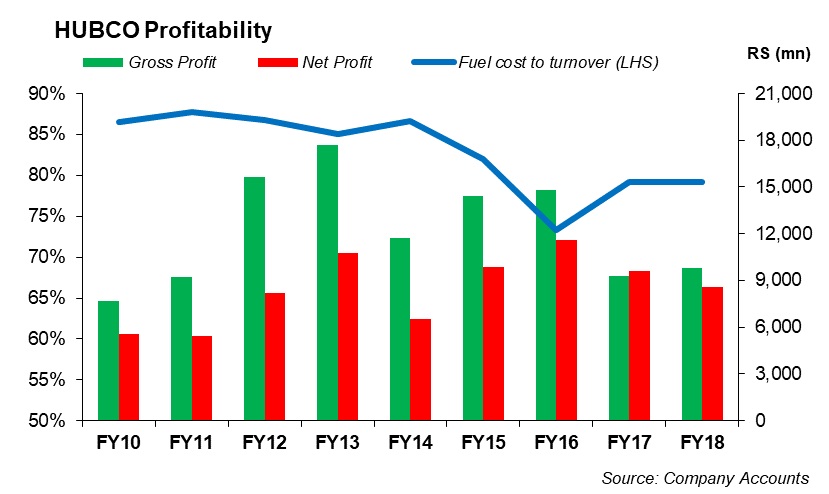
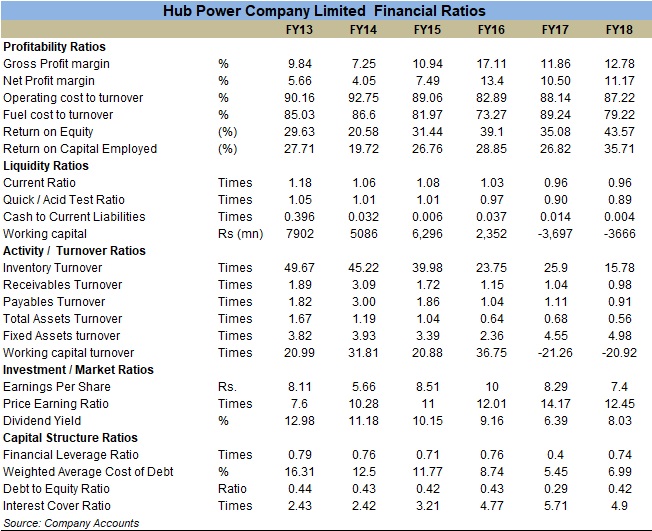
HUBC has been into aggressive revamping of its base business as well as growth plan over the last few years. In FY15, Hub Plant maintained an uninterrupted power supply to the national grid, were slight decrease in load factor came from a decrease in generation, caused by maintenance work on the boilers. The Narowal Plant too witnessed a decrease in load factor in the fiscal year due to the restriction imposed by the National Power Control Center. Its hydel power plant, Laraib had a higher capacity utilisation in FY15 due to better hydrology received from Mangla Power Plant and significant reduction in the number of annual maintenance days. In FY16, the Hub Plant's load factors improved as electricity generation during the year was higher due to higher availability and utilisation by the power purchaser.
Growth plans and revamping activity affected earnings; which improved a bit in FY16 when the power company decided to outsource O&M services to Hub Power Services. However, the consolidated earnings in FY17 came down significantly. The decrease in consolidated earnings as reported in the company's annual accounts was mainly due to higher repair and maintenance expenditure on major overhauling at Hub Plant and 36,000 running hours' major maintenance of six engines at Narowal Plant, lower indexation and exchange rate and higher losses of TEL and CPHGC as these projects are under construction.
Apart from that, higher general and administrative expenses and lower other income also affected the bottom line in FY17. HUBC posted a decline of 9.2 percent year-on-year in its profit for FY17where load factors slipped at Hub plant.
HUBC in FY18 and beyond
HUBC's financial performance in FY18 saw improvements in earnings despite a slight dip in revenues. The consolidated profit after tax increased by three percent year-on-year in FY18. The increase in profits came largely from lower repair and maintenance expenditure at Hub and Narowal Plants, partly offset by lower profits of Laraib, higher financing costs and administrative expenses.
During the year, Hub Plant's load factors dropped from 65 percent to 49.5 percent due to lower electricity demand from Power Purchaser. This was followed by Narowal Plant that too witnessed a decrease in load factors from 71 percent to 64 percent in FY18. During the year, overhaul of three engines and seven alternators at Narowal plant were out, and major overhauls of two engines and two alternators are planned for FY19. For its Laraib Plant, the annual maintenance was completed in 40 days versus 56 days' plan.
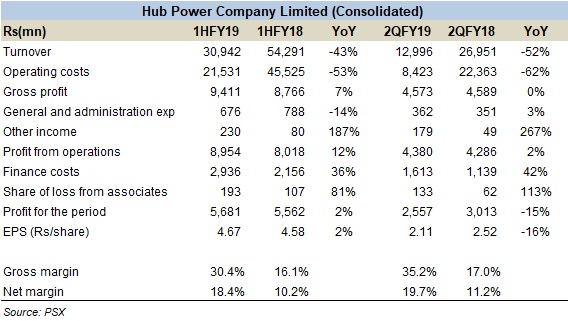
HUBC announced a decline in earnings for 2QFY19 and almost flat earnings for 1HFY19. The IPP's consolidated revenues dropped by 43 percent, year-on-year largely due to lower power dispatch to the NTDC system. Apart from the squeeze in the top line, HUBC's performance in 1HFY19 was dragged by growth in finance costs along with share of loss from associates.
Outlook
The company came up with HUBCO Vision 2025 in FY18, which was about growth including water utility to an existing power generation portfolio. As per the plan, the company envisions to own, operate and manage 10,000MW in and out of Pakistan by 2025, and to transform into an IWPP (Independent Water and Power Producer) by capitalising on opportunities in Pakistan as well as South East Asia, Africa and North America.
The company has plans to increase its installed capacity by 1650 MW, and amid the changing power generation mix, HUBCO has recently completed the acquisition of 37 percent stake in ThalNova Power Thar (Pvt) Limited through its subsidiary, Hub Power Holdings Limited. Back in 2016, ThalNova was granted a power generation license for setting up a 330-megawatt coal-fired power plant at Thar coal mine.
The power company has also signed a 330-megawatt financing document with Thar Energy Limited during the 8th Joint Cooperation Committee (JCC) in Beijing. HUBCO had earlier signed a shareholders' agreement with Fauji Fertilizer Company Limited and CMEC Tel Power Investments Limited for equity investment of 30 percent and 10 percent respectively, in the 330MW mine mouth lignite-based power plant at Block II, Thar. The project is a first when it comes to using local coal.
HUBC has also decided to increase its shareholding by almost double through its subsidiary Hub Power Holdings Limited in China Power Hub Power Generation Company (Pvt) Ltd (CPHGC) - one of the largest imported coal CPEC projects - from 26 percent to 47.5 percent. CPHGC is a JV between HUBCO and China Power International Pakistan Investment Limited (CPIPIL) for setting up a 2x660-megawatt imported coal-based power plants at Hub, Balochistan. The project is said to reach its commercial operation date by the end of 2020.
========================================================

The Hub Power Company Limited

Shareholding Pattern as at June 30, 2018   percentage

========================================================

Individuals

Local                                             15.79%

Foreign                                            0.14%

Joint Stock Companies                              1.26%

Financial Institutions                            16.46%

Investment Companies                               0.91%

Insurance Companies                                6.86%

Associated Companies                              37.78%

Directors & their spouse(s) and minor children     0.14%

NIT & ICP                                          0.37%

Modaraba/Mutual Fund & Leasing Companies          13.10%

Others-Government of Balochistan                   0.03%

Others-GDR Depository                              0.89%

Others-Charitable Trusts                           1.11%

Others-Cooperative Societies                       0.08%

Others-Provident/Pension/Gratuity Fund etc         5.07%

MEGA CONGLOMERATE (PVT.) LIMITED                     19%

ALLIED BANK LIMITED                                  10%

COMMITTEE OF ADMIN. FAUJI FOUNDATION                  9%

========================================================
Source: Company Accounts
========================================

HUBC-Key Projects at a Glance

========================================

Projects     Stake   Fuel Type       Net

                                Capacity

                                    (MW)

========================================

Hub Plant     100%          FO      1292

NEL           100%          FO       225

LEL            75%       Hydro        84

CPHPGC         46%        Coal     2x660

TEL (SECMC)    60%        Coal     1x300

========================================
Source: Annual Accounts